Pirate lore
Cutlasses and the Jolly Roger
The real weapons and flags behind a pirate show: what a cutlass was, who used it, where the Jolly Roger comes from and what the skull and crossbones meant.
Reserve a place on the galleon ↗Quick answer
A cutlass is a short, broad sabre that was a common naval weapon during the Age of Sail, and pirates famously used it. The Jolly Roger was the ensign a pirate ship flew before or during an attack, most often a skull on a black field. The skull and crossbones became the best-known version in the 1710s and 1720s. The Cozumel show's sword fights draw on this tradition.
The cutlass
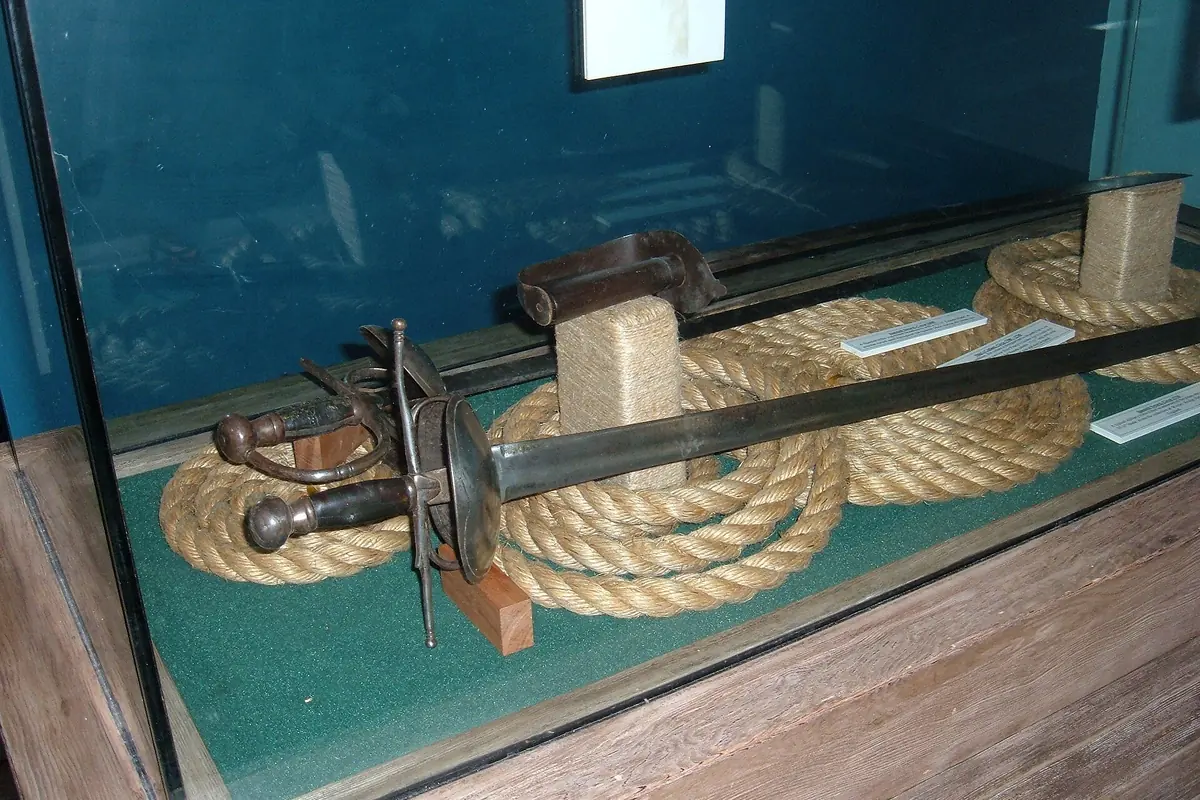
A cutlass is a short, broad sabre or slashing sword with a straight or slightly curved blade, sharpened on the cutting edge. Its hilt often has a solid cupped or basket-shaped guard. The word comes from the 17th-century English use of coutelas, a French word for a machete-like mid-length single-edged blade. It was a common naval weapon during the Age of Sail, so it belonged to ordinary sailors as much as to pirates. The one in the photograph below sits in a museum case beside coiled rope.
Why sailors liked it
The cutlass is best known as the sailor's preferred weapon. It was robust enough to hack or cut through heavy ropes, thick canvas and dense vegetation. It was also short enough to use in close quarters, such as boarding actions, in the rigging or below decks. Another advantage was its simplicity of use. It required less training than a rapier or a small sword.
Pirates and the cutlass
Cutlasses are famous for being used by pirates, although there is no reason to believe that Caribbean buccaneers invented them. Their use by pirates is well documented in contemporary sources, and the writer Alexandre Exquemelin reports a buccaneer using one in the 17th century. Pirates used these weapons for intimidation as much as for combat, often needing no more than to grip the hilt to make a crew surrender, or beating captives with the flat of the blade to force their compliance.
One word, two blades
In the English-speaking Caribbean, the word cutlass is also used for a machete. The weapon was as often a farm tool as a weapon, and it was commonly used in rain-forest and sugarcane areas, such as the Caribbean and Central America. That is a useful detail if you travel through the English-speaking Caribbean: the speaker may mean the everyday blade and not the pirate sword.
The Jolly Roger
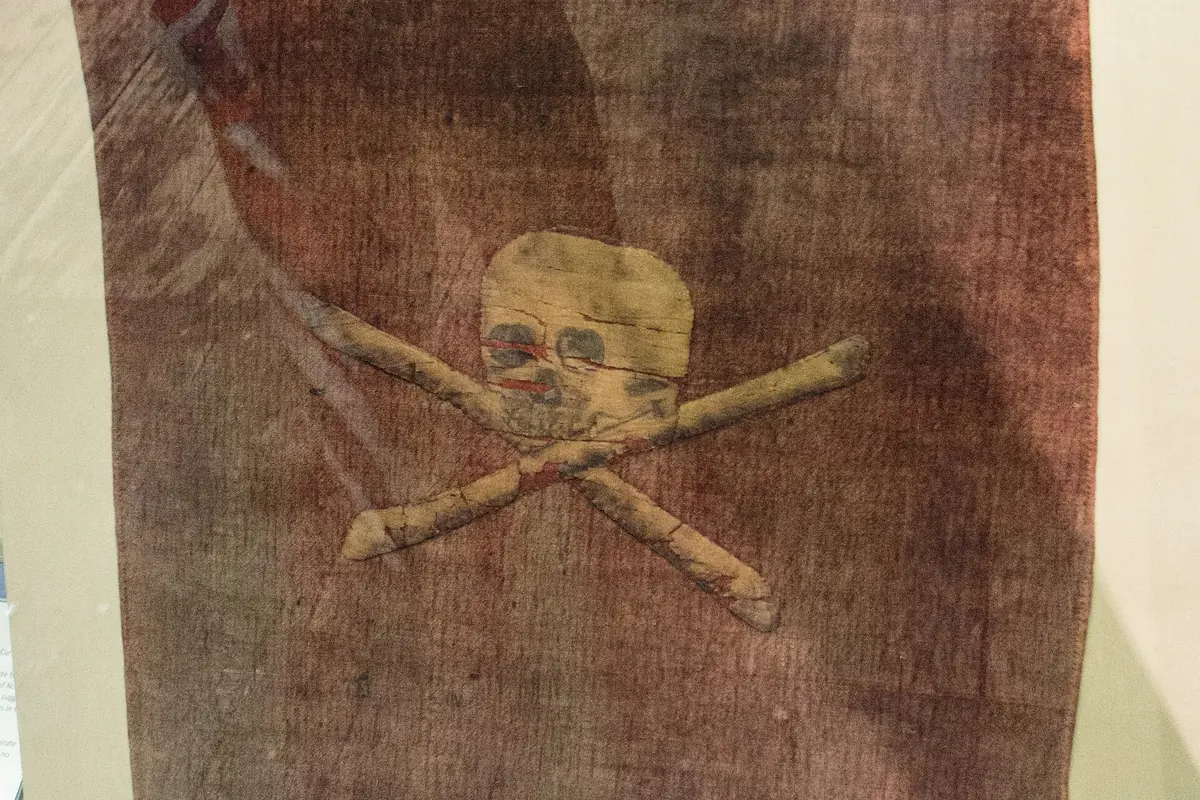
The Jolly Roger was the ensign flown by a pirate ship before or during an attack, in the early 18th century, the latter part of the Golden Age of Piracy. The vast majority of such flags carried a human skull, a Death's Head, on a black field, often with other elements. The skull and crossbones on black was used by a number of pirate captains in the 1710s. It became the most commonly used pirate flag in the 1720s, although other designs were also in use.
Where the name comes from
The term Jolly Roger goes back to at least Charles Johnson's A General History of the Pyrates, published in Britain in the 1720s. Johnson cites two pirates as having named their flag Jolly Roger. Their flag designs were very different, and neither consisted of a skull and crossbones. That suggests Jolly Roger was a generic term for black pirate flags, and not the name of any one design.
What it means for the show
A pirate show borrows these props: the sabre, the black flag, the swagger. Cozumel's pirate crew stages sword fights as part of an interactive show, and the weapons and flags in this guide are the history behind that costume. What the crew carries on a given night is for the crew to decide, so this guide describes the tradition and not the props.
Sources